Senin, 08 September 2014

HP USB 3 Button Optical Mouse in Retail Packaging

HP USB 3 Button Optical Mouse in Retail PackagingSmooth and Accurate The HP USB 3-Button Optical Mouse is the affordable desktop optical mouse solution that combines functionality with style

Price: $12.79


Click here to buy from Amazon

Read More..

Minggu, 07 September 2014

Day 3 A Hike to Kleine Scheidegg


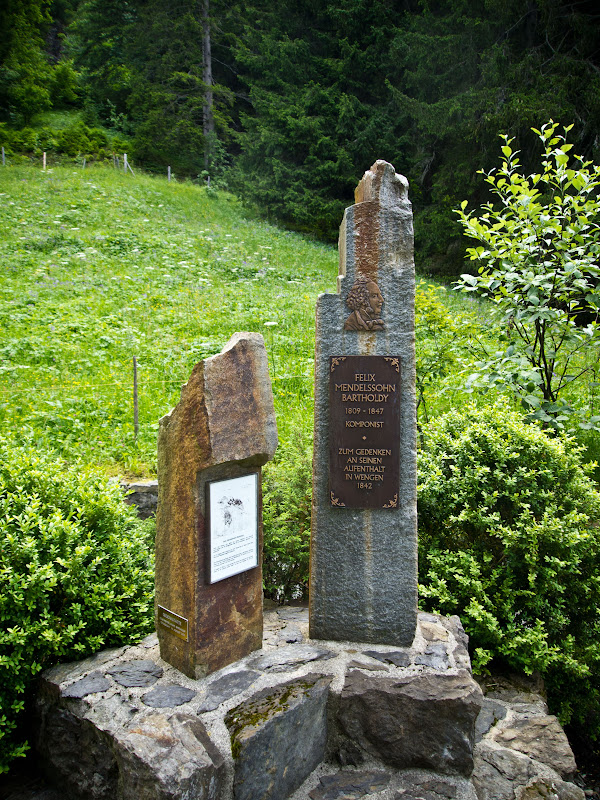
The plan for the day was for Phil and I to hike up to Mannlichen, where XiaoQin would join us via cable car. Then hopefully, wed do the mountain view walk together to Kleine Scheidegg and maybe back to Wengen, depending on how much walking we were willing to do. After a short quarter mile walk through Wengen, the trail led steeply up along the hillside. One look up the mountain and it was obvious why---the trail went alongside what was practically a cliff! It didnt take us long before we got to the Felix Mendelssohn Bartholdy memorial. I suspected but didnt know that he was the Mendelssohn, so I took a picture and moved on.


From Tour of the Alps 2011

Going higher up, the views opened up but because of overcast skies, we could not see far. We had been warned that this hike would be harder than usual because of constructions on the avalanche protection near the top, but were not prepared for signs like this:


From Tour of the Alps 2011

In the USA, these signs would be cause for a lawsuit were anyone to be injured by rock fall, and hence the entire trail would be closed, despite the fact that I did not see any possibility of rock fall.

Once we got higher, we saw some wildflowers and the pace slowed a little bit. I wasnt happy about the overcast, though, as it promised that our views of the mountains would be occluded.


From Tour of the Alps 2011

Sure enough, the panorama trail granted us only views of the base of the Eiger, the Jungfrau, and the Monch, and the best view of the mountains we got was further down, past the Kleine Scheidegg train station.


From Tour of the Alps 2011

We finished the hike one station down, got onto the train and then had a pizza dinner, hoping for some nice weather tomorrow before the serious riding began.

Previous
Next
Read More..

Sabtu, 06 September 2014

Inland USB Optical Mouse Black

Inland USB Optical Mouse (Black)This optical mouse is designed for comfortable computing and usability.Please avoid using the optical mouse on any reflective, transparent, metallic or complex-pattern surface.

Price: $14.99


Click here to buy from Amazon

Read More..

Jumat, 05 September 2014

Download Drivers on board ECS P4M890T M Windows XP 32 Bit

Classic desktop driver more important for old-fashioned personal computers, i provided for you here.
Download Drivers on board ECS P4M890T-M Windows XP 32 Bit
VIA HyperionPro Driver V5.12A
Download : Direct | Mirror

RealTek On Board LAN Driver 6.73
Download : Direct | Mirror

Realtek High Definition Audio Driver 1.92 (5618)
 Download : Direct | Mirror

VIA USB 2.0 Host Controller Driver 2.44
 Download : Direct | Mirror

VIA/S3G P4M890 VGA Driver 16.94.45.10
 Download : Direct | Mirror

VIA VT 6102 Rhine II Fast Ethenet LAN Driver
 Download : | Mirror

If you still need obsolete other models drivers, you can post comment for that models name, and i will help to find that drivers for you.

Read More..

Kamis, 04 September 2014

PCI Express 3 0 explained

What we do know though is what PCI-Express 3.0 will offer.


PCI-Express 3.0 explained
PCI-Express 3.0 looks the same as PCI-Express 2.0 from the outside


A Doubling of Bandwidth...
Following the tradition that goes back to AGP (remember that?), the bandwidth is again doubled from 500MB/sec or 4Gb/sec on PCI-Express 2.0 to 1GB/sec or 8Gb/sec on PCI-Express 3.0. Thats per lane, in each direction. This means the total bandwidth for an 16x PCI-Express graphics slots go up from 16GB/s to 32GB/s, so it should cope better with the future demands of high performance graphics cards.

To double the bandwidth the PCI-SIG hasnt just cranked up the transfer frequency by two though, instead its lessened the encoding overheads to make faster transfers more efficient.

GenerationBit rateInterconnect bandwidthBandwidth (per lane)Maximum bandwidth (16 lanes)
PCI-Express 1.12.5GT/sec2GB/sec250MB/sec8GB/sec
PCI-Express 2.05GT/sec4GB/sec500MB/sec16GB/sec
PCI-Express 3.08GT/sec8GB/sec1GB/sec32GB/sec

... but not a doubling of transfer rate?
Typically PCI-Express (and a whole lot of other signalling buses) use an 8b/10b encoding, which means ten bits are transferred for eight bits (one byte) of actual data. That 20 per cent overhead is considerable, and as weve seen from CPUs, frequencies cannot perpetually increase. This means that this overhead becomes ever more an issue as the bandwith increases.

To work around this problem, PCI-Express 3.0 encodes the data in a much larger 128b/130b chunk, and then a known polynomial is applied to a data stream in a feedback topology, with an inverse polynomial sat at the other end to decode the data. In more human terms, this is basically a hard-coded mathematical function that is designed to evenly spread the 0s and 1s (which are electrical clock blips), so they dont interfere with each other during transport. This technique is called scrambling.

This means the data transfer rate can be lower while still achieving the same real bandwidth. For example, instead of 5GT/sec of PCI-Express 2.0 increasing to 10GT/sec, PCI-E Express 3.0 only needs 8GT/sec. Less transfers mean greater efficiency - so PCI-E Express 3.0 also uses less power - and it doesnt have to use higher grade materials - so the products are cheaper to make. Win-win.

However, PCI-E Express 3.0 provides no more power than its predecesors - but thats actually a good thing. Having >300W drawn from each 16xPCI-E slot would drive up the cost of motherboards, as the copper traces on the motherboard would need to be thicker. Manufacturers might even need to add extra layers to try and route these high power traces and their associated electromagnetic interference away from sensitive data traces.

Finally, PCI-E Express 3.0 has the same physical characteristics as PCI-E Express 2.0, so its backward compatible with previous versions of PCI-Express, regardless of the data encoding change.


Upgrade to a FileSonic Premium account and download at incredible speed!
Read More..

Rabu, 03 September 2014

What Happens When You Press A Key


To illustrate how the computer works, lets take a very simple example. Lets suppose you are working in your word processor and you type the letter "M". Heres what happens, in general terms, when you press the "M" button:
The keyboard sends an electrical signal, called a scan code, to the computer saying that a button was pressed.
The keyboard controller interprets the scan code and determines that the letter pressed was an "M". It stores this "M" in a special memory location until the processor is ready to deal with it.
The controller sends a signal to the processor, called an interrupt. An interrupt tells the processor that some part of the computer has information for it to process and wants its attention. In this case, the keyboard controller wants the processor to look at the key you just pressed.
The processor is almost always doing many things, sharing its time among many tasks. As a result, most every event must wait its turn. The processor services interrupts based on their priority. When it is time to deal with the keypress, the processor routes it to the program for the operating system that you are using.
Assuming you are using a multi-tasking operating system like Windows, the operating system software decides which window you pressed the key in and sends a message to that window telling it a key was pressed.
The window decides what to do with the keypress. Since in this case its your word processor window, and the key you pressed was an ordinary letter, the word processor will add that letter to its working area for the file you have open. The letter will take one byte of your computers memory (RAM). Other keys could be handled differently (for example, if you pressed the key to tell the word processor to exit).
The window will then call the operating system to display the letter on the screen.
The operating system will display the letter on the screen by adding it to your video cards video memory.
The next time the video card refreshes your monitor (re-displays what is in its video memory) the letter will appear on the screen. Most video cards refresh the monitor between 60 and 100 times per second.
Wow, a lot happens even in a simple example like this! This all appears to occur instantaneously because the computer is simply operating at a much faster speed than humans can readily perceive. But despite the illusion created by the speed of the PC, a lot of activity is going on inside the box for even the most basic activity.
In fact, even in the description above, I omitted many steps and details. To list every single step could take dozens of pages, even for just this simple example! The processor itself is handling many thousands of chores every second, and every part of the computer has a job to do on an ongoing basis. This hopefully gives you some idea of how the computer processes, moves, and stores information. Notice that in this example all three activities occurred.
Read More..

Selasa, 02 September 2014

Hard Disk Basics

Hard Disk Basics

Hard disks were invented in the 1950s. They started as large disks up to 20 inches in diameter holding just a few megabytes. They were originally called "fixed disks" or "Winchesters" (a code name used for a popular IBM product). They later became known as "hard disks" to distinguish them from "floppy disks." Hard disks have a hard platter that holds the magnetic medium, as opposed to the flexible plastic film found in tapes and floppies.

At the simplest level, a hard disk is not that different from a cassette tape. Both hard disks and cassette tapes use the same magnetic recording techniques described in How Tape Recorders Work. Hard disks and cassette tapes also share the major benefits of magnetic storage -- the magnetic medium can be easily erased and rewritten, and it will "remember" the magnetic flux patterns stored onto the medium for many years.

Read More..
 
Powered by Blogger .
Converted To Blogger Template by Anshul .